Back to Tech Blog
Technology
March 4, 2026
Energy systems modelling in the AI era
Summary

AMP is an AI pair-modeller embedded directly in Scenario Builder, bringing the speed of AI coding assistants to energy systems modelling.
Grounded in your scenario data and documentation, AMP helps diagnose infeasible runs, explain model behaviour, and turn research questions into structured scenarios.
By reducing debugging time, data friction, and manual configuration, AMP makes energy system planning faster, more intuitive, and more accessible.
The rise of AI in software development has led to a paradigm shift often referred to as 'vibe coding'. Developers increasingly describe their overarching goals and architecture in natural language, while AI handles the boilerplate syntax. The developer focuses on the ‘vibes’ — the strategic outcome — and acts as a reviewer rather than a typist.
At TransitionZero, our engineering team leverages AI coding assistants daily. We, like many others, are seeing significant speedups in feature development, maintenance, and debugging. We conceived AMP as a way to bring similar benefits to our internal energy systems modelling team.
In early testing, we observed that flagship LLMs have a strong conceptual understanding of energy systems modelling. However, their ability to do real energy systems modelling work out-of-the-box is limited due to:
- Data-heavy: Context window limits prevent ‘brute force’ upload of data for all but the smallest energy planning scenarios. LLMs can struggle to reason over large data files
- Task variety: Modellers are responsible for data collection and validation, debugging of failed and infeasible runs, and calibration against historical data. Out-of-the-box LLMs struggle here because these tasks require multi-step, iterative trial-and-error. The AI tooling ecosystem for energy systems modelling is immature or non-existent
AMP: Your AI pair-modeller
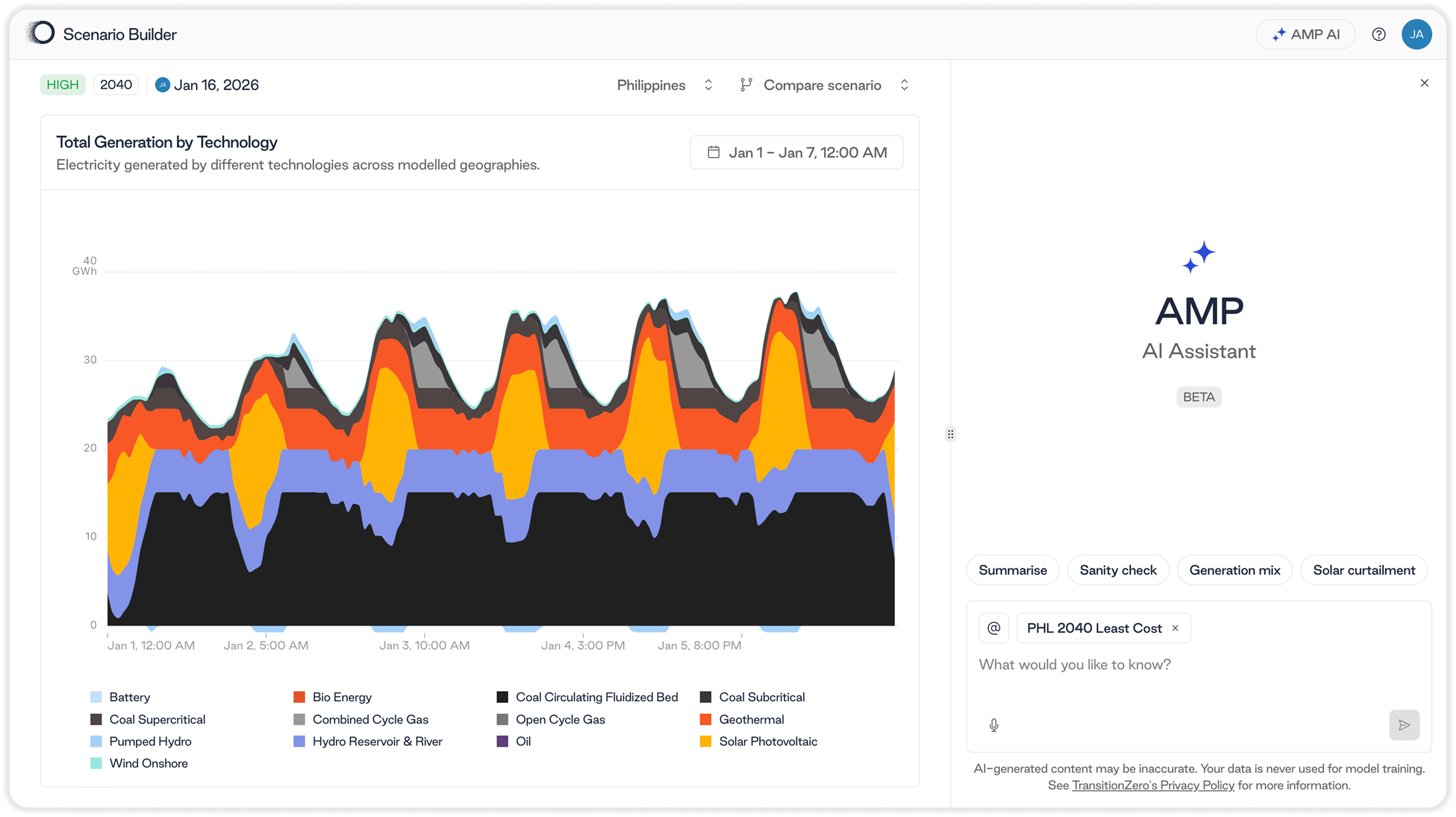
AMP is an AI system embedded natively into Scenario Builder, TransitionZero's no-code power systems modelling platform. It has direct access to your scenario data, allowing it to sanity-check your inputs, explain your results, and help you actively build your models.
Just as AI coding assistants abstract away programming syntax, AMP abstracts away the friction of data entry. You can ask it high-level questions, and it will interact with the specialised tools required to configure your scenario. Key use cases include:
- Contextual Analysis: AMP reads your scenario's inputs and results. Ask, "When does the system stop burning coal and why?" and AMP will reason intelligently over your results and constraints to provide an explanation
- Infeasibility Analysis: Model debugging can be tedious. When a model run fails, simply ask, "Why is this scenario infeasible?" and AMP will scan your inputs for conflicts and give suggestions for next steps
- Scenario Editing: Turn research questions into reality. Prompt AMP to "Help me test the impact of several gas price scenarios," and it will guide you through the process of converting this into scenarios and data inputs.
- Documentation Retrieval: Unsure about our methodology? AMP has access to our complete documentation. Ask, "How did Scenario Builder source its data on Singapore?" for immediate, fully-cited answers
Trust and hallucinations
AI tools can be treated with suspicion due to their habitual ‘confident incorrectness’, or hallucination. Often, the burden of validating the response of the LLM nullifies the time saved when using it for work. This has been less of a problem in the world of AI software development, where existing QA processes such as code review and automated testing work out-of-the-box, and AI tooling is rapidly maturing.
A common way to reduce the scope for LLM hallucinations is grounding: presenting relevant context to the AI when generating a response. We ground AMP with:
- Detailed Scenario Builder and energy systems modelling context in its system prompt
- Up-to-date access to the Scenario Builder docs
- Direct access to inputs and results for attached scenarios
We are confident in AMP’s ability to give reasoned and correct responses:
- We test AMP on a diverse benchmark dataset, covering a wide range of scenarios and capabilities as well as security threats
- We deploy AMP internally for real energy systems modelling work, allowing us to beta test internally. What works well for our modellers gets published externally having already been road-tested
A hallucination-free system is impossible. Our internal infeasibility diagnosis benchmarks show that AMP correctly pinpoints the root cause of infeasibility in 70% of our benchmark test cases. 30% of the time it is wrong. We believe that the time saved on this task is worth the time spent verifying each answer.
Internal Case Studies
During our internal beta, our modelling and engineering teams used AMP to dramatically speed up their workflows. Here is how it is already changing the way we work:
- Rescuing Infeasible Runs: A modeller calibrating Scenario Builder’s long-term Indonesia scenario ran into an infeasibility. Instead of spending hours debugging, they asked AMP. Within seconds, AMP identified that a minimum and maximum growth constraint were in conflict. AMP suggested the exact edit needed to resolve the conflict
- Contextual Debugging: When reviewing results, a modeller noticed an unexpected spike in gas generation during a high-solar month. AMP correctly identified that while solar availability was high, transmission constraints between two key regions were forcing local gas plants to turn on to meet peak evening demand
What’s next?
This is the first release of AMP, and we are already working on expanding its capabilities.
- AI scenario editing: Currently in internal beta. For complex research projects or iterative scenario calibration, natural language scenario editing – with human validation – is saving our modellers huge amounts of time, reducing manual input and context switching
- Scaling: Currently, the biggest model on Scenario Builder has 10 spatial nodes. As scenario sizes grow, exploring data efficiently becomes more and more challenging
- Autonomy: We believe AMP can automate some iterative modelling tasks. For more challenging infeasibility diagnosis, AMP might suggest a sensitivity analysis or a backstop technology, solve models and reflect on the results before giving its answer
Scenario Builder drastically reduces the time it takes to model your energy system, with out-of-the-box datasets and optimisation in the cloud. We believe AMP will reduce this further, making energy system planning more accessible, faster, and more intuitive.
Log in to Scenario Builder, open AMP, and start modelling. We’d love to hear your feedback.