Back to Insights
Update
May 7, 2026
Spain's solar surge and the case for energy resilience: the Q1 2026 Solar Asset Mapper release
As fossil fuel markets reel from the Iran crisis, TZ-SAM's latest data shows how countries investing in solar are reaping the rewards. Spain is leading the way in Europe.
Summary

TZ-SAM now tracks over 108,000 solar facilities across 191 countries, with a total detected capacity of 1,331 GW, a 6.8% increase from Q4 2025.
Africa recorded the fastest regional growth at 12.2%, while Asia continues to dominate in absolute terms with 839 GW of detected capacity.
Spain, now widely cited as Europe's poster child for energy resilience amid the Iran crisis, has 46 GW of detected solar capacity according to TZ-SAM, the largest in Europe, while recently commissioned projects like Zelestra's 162 MW Belinchón cluster highlight the continued pace of buildout.
The global picture
Solar deployment continues to accelerate, and keeping track is no small feat. That's where TZ-SAM comes in: a global, asset-level solar dataset built using planetary-scale machine learning. Our latest release captures commercial- and utility-scale solar installations through to the end of Q1 2026, offering the most up-to-date view of solar's rapid expansion. Learn more about TZ-SAM's origins in our Explainer.
Today, TZ-SAM tracks over 108,000 solar facilities across 191 countries. The number of tracked facilities represents a 1.4% increase from the Q4 2025 release. The dataset includes location, capacity, and estimated construction dates for installations with a capacity >= 1 MW. Around 1,535 additional solar assets have been detected in this release, covering an additional 2,355 square kilometres, an area roughly the size of Luxembourg. Total detected capacity has grown by 85 GW to 1,331 GW, representing a 6.8% quarterly increase.
Regional trends: who is growing fastest?
One great advantage of consistent and regularly updated quarterly data is the ease with which we can track trends at the regional level. Here's where things stand at the end of Q1 2026
Asia continues to dominate, with 839 GW of detected capacity, a 7.4% quarterly increase. China alone accounts for 576 GW, up 7.1% from Q4 2025. India's detected capacity crossed the 100 GW mark for the first time, reaching 102 GW (up 10.9%).
Europe reached 202 GW, growing 5.7% quarter-on-quarter. Spain leads the continent with 46 GW (up 5.5%), followed by Germany at 37 GW (up 6.2%), Italy at 21 GW (up 4.8%), the United Kingdom at 16 GW (up 4.6%), and France at 14 GW (up 3.8%). Poland crossed the 10 GW mark, reaching 11 GW (up 6.4%). Further down the table, Romania (up 11.4%), Sweden (up 14.0%), and Moldova (up 30.2%) posted some of the highest European growth rates this quarter. North America sits at 201 GW (up 5.3%), with the United States accounting for 179 GW. South America grew by 6.5% to 55 GW, led by Brazil at 33 GW. Oceania grew 7.7% to 17 GW.
Africa recorded the fastest regional growth at 12.2%, reaching 17 GW. South Africa leads the continent at 7 GW (up 14.9%), followed by Egypt at 3 GW (up 9.9%). Several smaller markets showed notable acceleration: the Democratic Republic of the Congo grew 67%, Chad 76.2%, and Eritrea 79.6%, albeit from small bases.
Country-level highlights
The global top 10 leaderboard by detected capacity according to TZ-SAM in Q1 2026:
Notable movers this quarter include Iraq (up 490.6% to 0.3 GW) and Laos (up 269.6% to 0.5 GW), both from small bases but indicative of how quickly solar markets can emerge. In Europe, Romania (up 11.4% to 5 GW) and Sweden (up 14.0% to 0.7 GW) are growing quickly, while Ireland has seen particularly rapid growth over the past year, reaching 1.5 GW from just 0.9 GW three quarters earlier.
Spotlight: Spain and the solar resilience dividend
Spain has become one of the most closely watched energy markets in the world. As the Iran crisis has disrupted oil and gas supplies through the Strait of Hormuz, typically carrying around a fifth of global oil and liquefied natural gas, countries heavily dependent on imported fossil fuels are facing surging energy prices. Spain, by contrast, has been comparatively shielded. According to grid operator Red Eléctrica, renewables generated 56% of Spain's electricity in 2025 (57% including self-consumption), with nuclear providing a further 19% and combined cycle gas just 17%. Wind led the generation mix at 22%, followed by nuclear and solar PV at 18%. This diversity of low-carbon sources means natural gas rarely sets the marginal price for electricity, keeping bills lower than in many neighbouring countries.
Official figures from Spain's grid operator Red Eléctrica place the country's installed solar capacity at approximately 50 GW as of early 2026. TZ-SAM detects 46 GW of solar capacity in Spain, the largest in Europe and up 5.5% from Q4 2025. The gap is expected: TZ-SAM focuses on commercial- and utility-scale installations detectable from satellite imagery, and Spain has 9.3 GW of rooftop and distributed self-consumption solar that falls below TZ-SAM's detection threshold. This comparison illustrates how TZ-SAM data can be used alongside official statistics to build a more complete picture.
Over the past year, TZ-SAM has tracked Spain's detected capacity growing from 40 GW in Q2 2025 to 46 GW, an increase of nearly 5.6 GW in just three quarters. Spain's solar buildout has not slowed down. Two recently commissioned projects demonstrate the pace and scale of deployment:
Zelestra's Belinchón cluster (162 MW): Three solar plants (Belinchón I, II, and III) located in Cuenca, Castilla-La Mancha, were commissioned in March 2026 after just 14 months of construction. With 275,000 solar modules across the three sites, the cluster is expected to avoid more than 42,700 tonnes of CO2 emissions annually. The projects are backed by long-term power purchase agreements under Schneider Electric's Energize programme, supporting pharmaceutical supply chain decarbonisation.
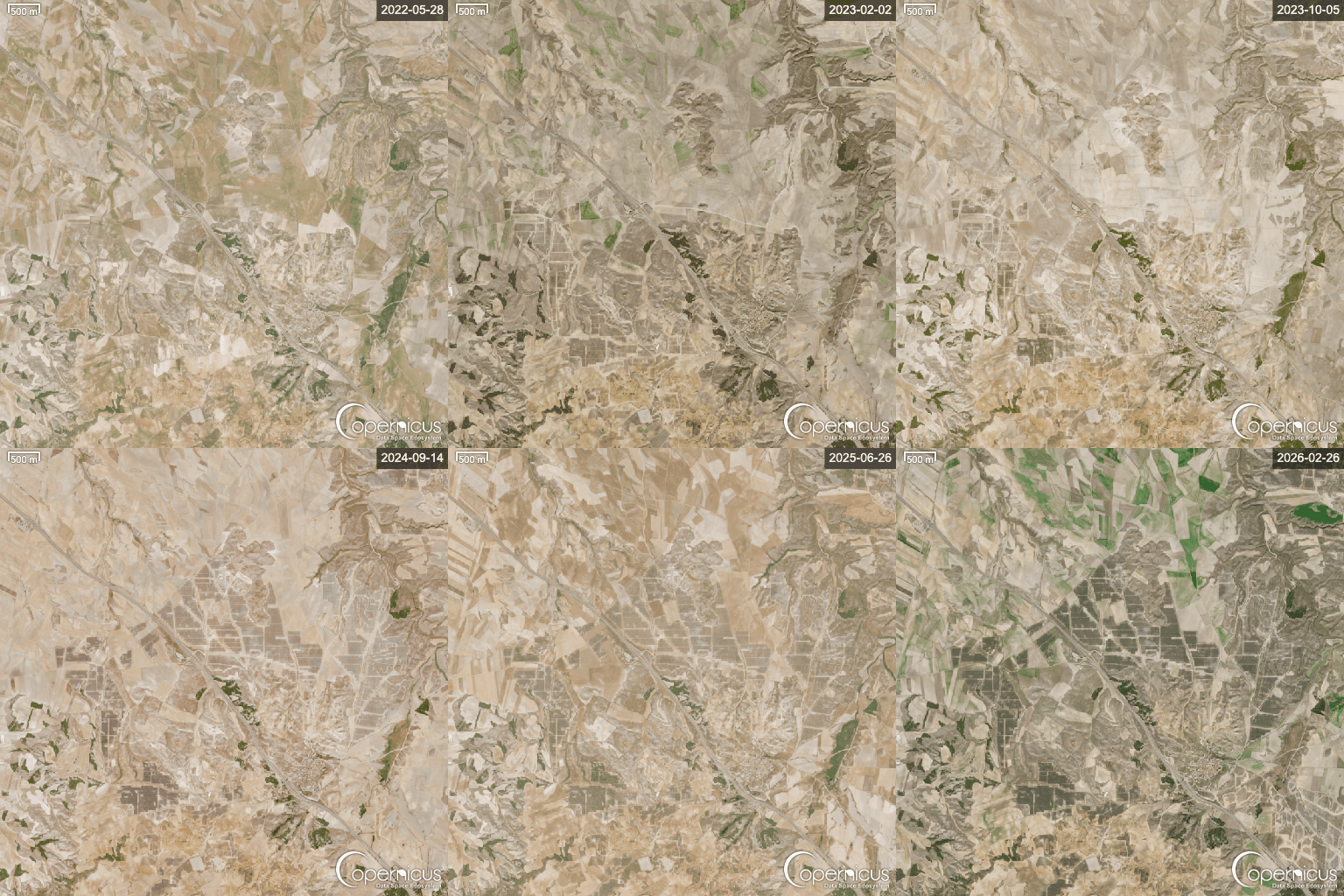
Time lapse of Belinchón solar plant in Cuenca, Castilla-La Mancha, Spain
EDP's Cierzo solar plants (90 MW): Two photovoltaic plants, Cierzo II (42 MW) and Cierzo IV (47.5 MW), were commissioned in Navarre in early 2026. Together, they comprise more than 160,000 solar modules and are expected to generate enough electricity for approximately 45,000 homes. EDP built dedicated grid infrastructure for the projects, including a 2.5 km, 400 kV transmission line.
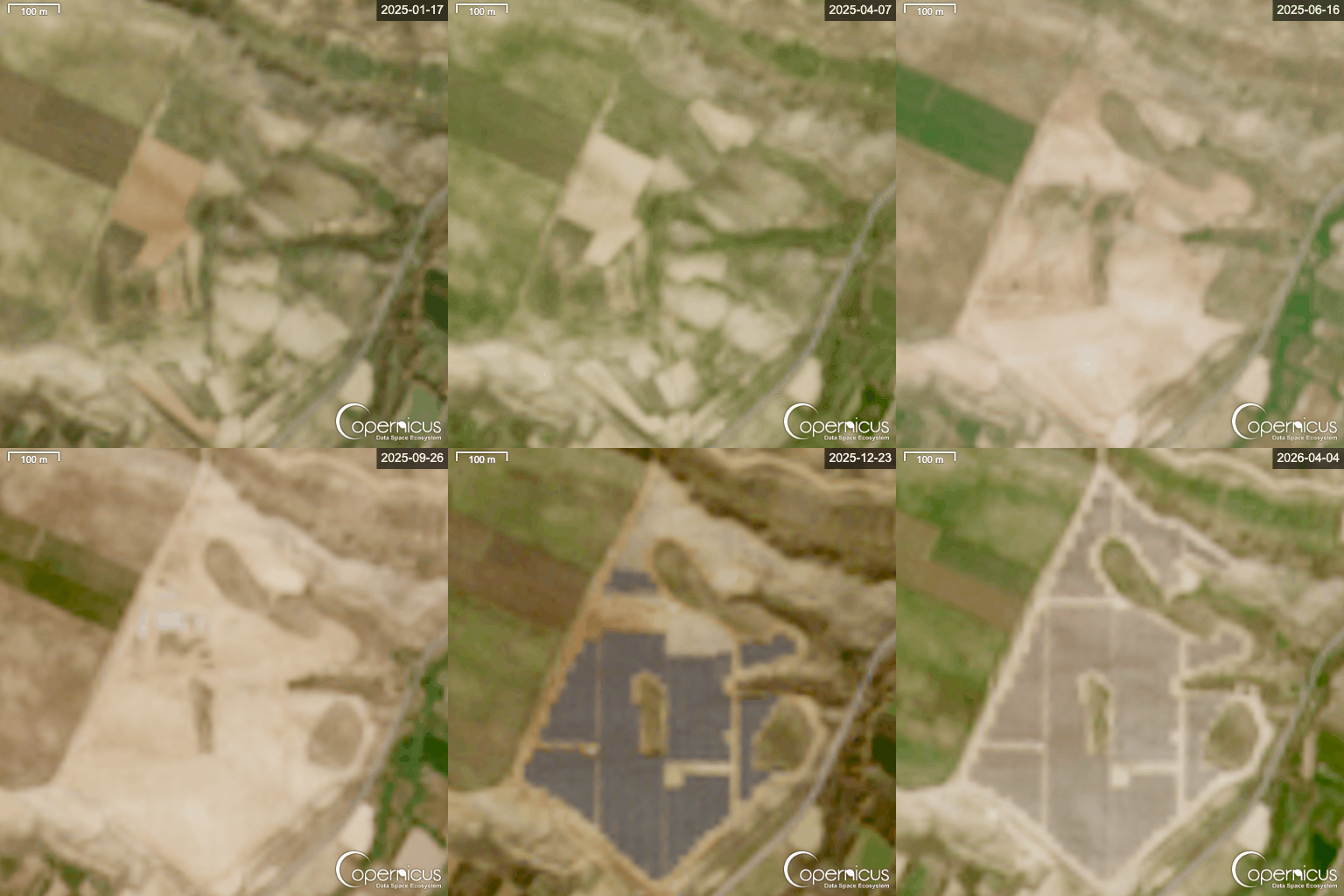
Time lapse of Cierzo II solar plant in Navarresolar plant in Navarresolar, Spain
These projects can be cross-referenced with TZ-SAM's latest detections in the Solar Asset Explorer, Belinchón cluster, Cuenca and Cierzo II, Navarre, demonstrating the dataset's ability to track the pace of deployment at the project level. As the debate over energy security intensifies, granular, up-to-date data on where solar assets are being built and how quickly has never been more important.
When is the next release?
TZ-SAM data is published retrospectively, with data for the preceding quarter delivered in the current quarter.
TZ-SAM users who tick the box opting in for quarterly release updates when downloading TZ-SAM have the data delivered directly to their inbox.
Using TZ-SAM data
By tracking both the number of utility-scale assets and the estimated capacity of those assets, TZ-SAM data can show how macroeconomic trends and policy decisions impact solar deployments and the broader energy transition. The Solar Asset Explorer is an interactive web interface for exploring TZ-SAM data, offering clickable polygons with key asset details and raw satellite imagery behind the detections.
TZ-SAM is available under two licensing tiers. Academic institutions, NGOs, and government bodies can access the dataset free of charge for non-commercial research and analysis. Commercial organisations can purchase a commercial licence.
Download TZ-SAM now, and register for quarterly updates.
TZ-SAM is built and maintained by Mason Phillpott, Senior Data Scientist; Joe O'Connor, Head of Machine Learning; Max Santos, Data Scientist; and Michael Guzzardi, Senior Platform Product Manager. Insights and communications by Hannah Brennan, Communications and Marketing Manager.